News: What’s about to happen… New releases, Networking, Sŵn Festival and more!

I briefly spoke about what’s been going on this year, but didn’t mention what’s about to happen…

Workflow has been few and far between due to increased live shows and the day job. I spent quite a bit of time concentrating on how I was going to start performing my music live. Chose a drum kit, and created an Ableton Live template to have running beside me with my Livid Instruments CNTRL:R, a small Korg Volca Keys Synth, and sometimes a little Akai MPK Mini 2 Keyboard (mainly for playing the synth). Playing that synth live is a pain on the ribbon controller…

I’ve still got a lot of work to do on the live aspect of playing. I make a point of meeting members of the audience and talking to them about what they enjoyed, and try getting some honest critisism. Some love it, but some get bored of seeing someone ‘just play drums’ and want to see something more. I try to put as much into my live show as possible when I’m playing, but I think taking it one step further may be the key.

First of all what I’m playing. Live drums can’t be good enough if I’m just playing what’s already on the track, so my aim is to start experimenting more. Filling the holes a little, stripping back to the idea of live drums being texture to add to the production, something extra you don’t hear on the original to make my live shows unique. I discovered more recently that if I try recording my drums to place into my productions that it kills the need for them live, but I don’t want that to happen. For this reason I think the most I’ll ever record in is the odd cymbal or percussion. Adding a live sound on top of electronic drums is so much more powerful.
Imperfections V3

NEW EP RELEASE 10/07/14

With this in mind, on the 10th July I’ll be releasing a new EP for you all to enjoy, entitled ‘Imperfections’. This release for me is a middle ground. I’m wanting to release another album by the end of this year, but that’s quite far away, so I wanted to get something out there for you all to enjoy in the meantime.

This EP is made up of 4 tracks… ‘Running Crows’, ‘Dancing Dragons’, ‘New Dreams’, and ‘Underwater Coin Catcher’.

I wanted to keep a vibe going throughout the EP, so I spent an afternoon creating ideas for it a few weeks ago in one session (picture below high on caffeine after I’d finished the session in my living room). Those ideas I arranged a week later in my studio, and I’ve been mixing them whenever I’ve had the chance to since. Finally I’m at a point where I’ve just got a few small changes to make before mastering them to send to you, and I really hope you’ll enjoy it.

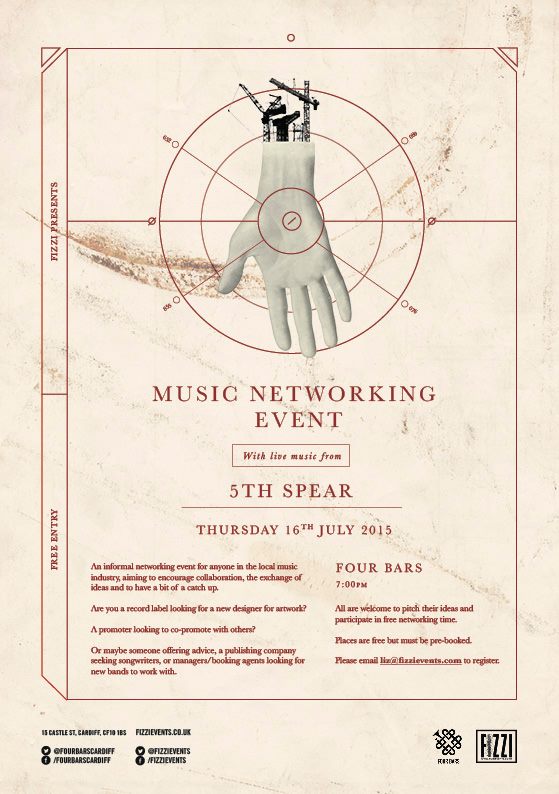
I’m planning to do a short performance of this EP along with a couple of older tracks on the 16th July at Fizzi’s networking event at Fourbars in Cardiff. This is a free networking event for musicians and creatives to get together and meet each other. Create contacts, make friends… It was a great evening last time, and I’m so pleased to have been invited back to play for them. Although it’s a little nerve wracking.
11108954_502456543239258_3952102485539911084_n

Free Music Networking Event 16/07/15

I would also like to mention that after the previous meetup I got in contact with Ian Tully, one of the attendees who runs ‘Cardiff Electronic Producers Group’ on Facebook. These guys meet up once a month or so, and the next one will be held at Waterloo Gardens Teahouse in Penylan, Cardiff on the 30th July. I’ll be there so it would be awesome to meet some fellow producers.

Last but CERTAINLY NOT LEAST I would like to announce that I’ll be playing Sŵn Festival 2015 in November. Details about venue etc will be announced closer to the time, but I’m so very pleased to be featured at this event.
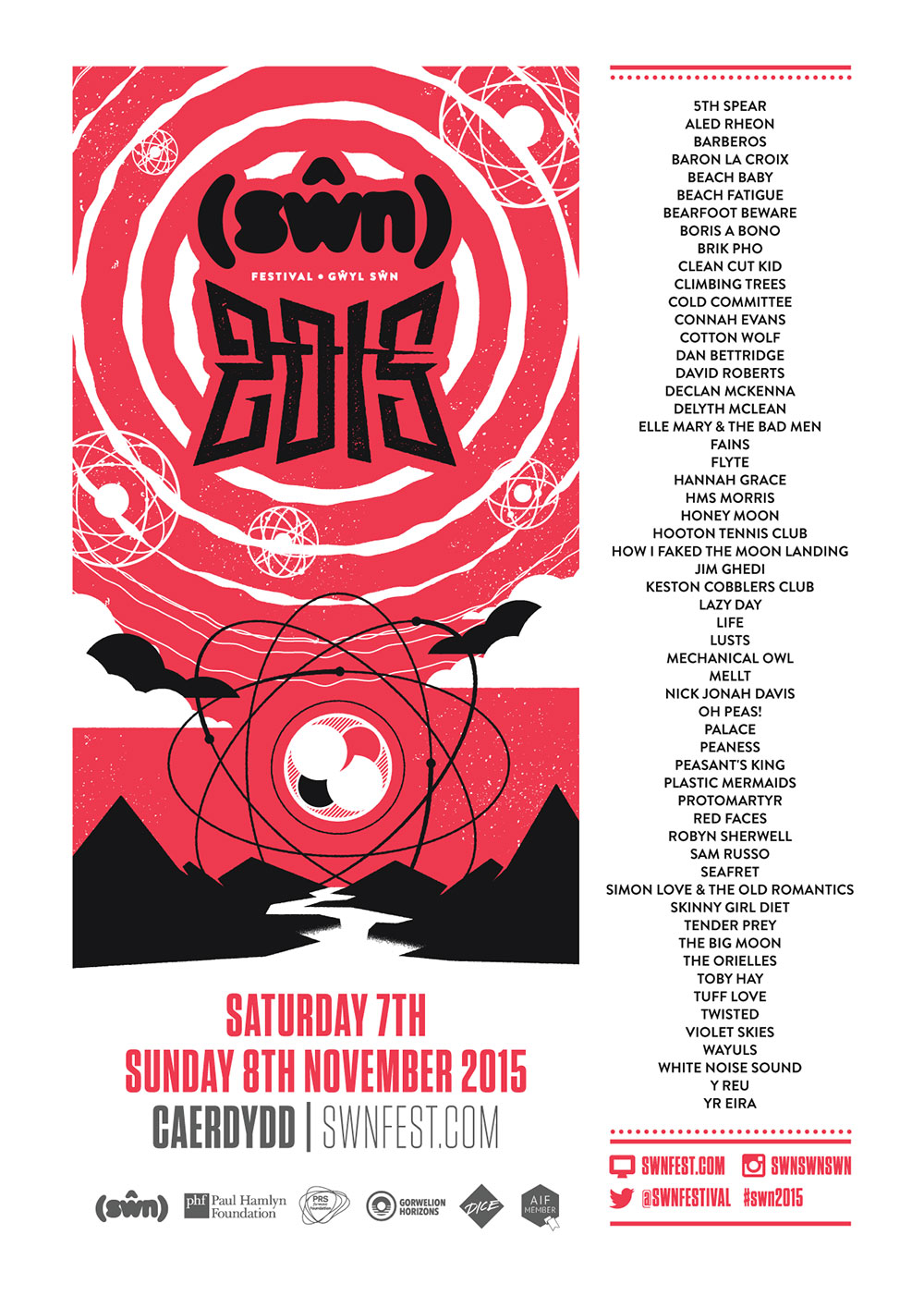
swn-festival-listings-poster-web“This year’s Sŵn will take place on Saturday 7th and Sunday 8th November (a little later than usual due to the Rugby World Cup) across a bundle of venues in Cardiff. If you’re new to the festival, all you need to know is that one wristband gets you in to all the venues (subject to capacity), as you walk/run/meander around to discover as much new music as possible.” – http://swnfest.com/

It’s always nice to see how other people describe you too –> http://swnfest.com/artist/5th-spear-2/
News: What’s been going on… (With audio and video to enjoy)

So, previously I spoke about the beginnings of this year. Playing ‘Dim Sŵn’ in April, and the following gigs that playing such a great festival led to.

Well I have to say I’ve been kept busy. Since I’ve supported Bloodsport and Giant Swan at The Abacus, an art gallery that replaced the old bus station ticket office here in Cardiff. It was such a cool little venue to play, and the bands I was supporting were great to meet, making some awesome noises. Both bands were experimental and unique in their own way. I was massively impressed by Giant Swan’s crazy setup of of drum machines and guitar pedals. I felt silly asking them afterwards whether they had sidechain compression setup in there somewhere, the kicks were pumping so much. They didn’t even know what i was talking about. Pure, clean, analog noise. Awesome.

Shortly after I was given the honour of supporting ‘Slowly Rolling Camera‘. A band consisting of some AMAZING musicians, with jazzy electronic sounds often compared with ‘The Cinematic Orchestra’. I felt so lucky to support these guys, and to see some old friendly faces again. Their drummer being the amazing Elliot Bennett, and the tech head behind it all Deri Roberts, not forgetting their amazing bassist Aidan Thorne. All of which and worked with whilst studying at Uni. It was great to see what they’d moved on with and accomplished together.

This set saw me stripping back to just a laptop (no drums), controller and new Korg Volca Keys synth I’d picked up the week previous. It was an odd situation playing at the back of the venue next to the mixing desk, which I quite enjoyed as for once I could hear what the audience were hearing, yet led to people wondering when I was playing, thinking that I was DJing. However, it did lead to some wonderful comments such as ‘Is this Goldpanda‘ or, ‘This really sounds like Bonobo‘. I saw this as a good thing.

Anyway. My brother caught a few short clips and here was my fave.

Next saw me playing at Gwdihw. A small popular alternative bar tucked around a corner in Cardiff City Centre. They get quite a few bands playing in there, but this was a first collaboration between ‘All My friends‘ and ‘Electronic Music Wales‘, a night I hope they continue to do. All acts were electronic based. A duo called ‘Superhand‘ were headlining, with fellow support from a new group called ‘Ghostlawns’.

Superhand had elements of Clark in there, with vocals that reminded me of Emika. Some really nice chilled vibes, but crazy at times.

Electronic Music Wales were nice enough to invite me down to the venue for an interview earlier in the week, with a very passionate blog runner Harish. This was my first video interview, so I had no idea what to expect………..

I later got a last minute opportunity to play a short set at a new venue. Ten Feet Tall.. This was an odd mix of bands playing together. Fellow support were ‘How I Faked the Moon Landing‘, and indie band fueled by sounds akin to The Killers.

Tellison were great headliners, and again another great band to meet. Lovely guys, the lead having a day job working for Sega, which is freakin’ sweet. Their sound was a mish mash of bands such as Death Cab for Cutie and Reuben etc. One of the first bands in a while that I’ve walked up to afterwards and requested to buy a CD from, and I’m still listening to it. Some great tracks from these guys. Certainly my ‘cup of tea’ when I’m in the mood.

So that’s what’s been going on… Expect an update of what’s about to happen shortly…

[Due Update] Writing Music No.1 (2012)

Over the past couple of days I’ve been poking my head around websites with articles related to writing music. I have to say. There aren’t a lot that really give you any help. A lot of them are extremely basic, and I can understand how this might aid people who are literally just starting to write, but what about the people who have been writing for years?

Now, I’m not exactly a pro. My tracks are proof of that, but I have been trying my hand at writing for a long time. I began with my guitar and voice, writing singer/songwriter stuff influenced by people such as John Mayer, Dave Matthews, City and Colour, and more. I did this for quite a few years, from that age of about 15 until I was around 19/20. I still do, and I know that compared to some people those 4/5 years are nothing, but I learnt a lot from doing that. I didn’t have any official training, the only instrument I had to been taught was Drums (and a little bit of piano when I was even younger), but my guitar and voice was simply through self-learning. I didn’t use tabs, I used my ear (a technique that everyone should try). The great thing about using my ears was that I soon realised that most of the guitar tabs you found online were wrong, and that they were simply using the root notes of the chords being played, rather than actually using what the original writer had intended. These are the types of chords you hear being played by buskers on the highstreet as they scream their lungs out thinking that they’re amazing. I tell you what, the ones I actually pay attention to or even give money to, are the ones that either make the song their own, or play the actual chords.

Sidetracking again, but basically, I had those few years of playing guitar, going to open mic nights, playing at my own nights, and even being invited to play at Glastonbury Festival with my band at the time. One thing I discovered though whilst writing my own stuff, the song for my acoustic band, and the songs for my ’emo/screamo’ band at the time, was that you found yourself writing completely different styles, (obviously) but your writing style would be completely different also. Styles, build-ups, structure. They were all different. This brings me back to my opening comments.

I recently posted up a blog about templating creativity, for myself, it’s exactly what I needed to do. I struggle to find the time to actually sit down and write music. Making that template has increased the possibility that I’ll actually get to do so, and the arrangement/structure template I’m using will also aid in that, but I find myself listening to tracks I had written when I first started using Music Software (whilst I was studying at A-Level), and I listen to the MUSIC side of things thinking, ‘How on earth did I come up with that?’.

To be honest, I think that the reason I was writing music back then, that I struggle to write now, was purely down to not having been taught how to write music. You might find that comment funny, but if you look at most of the musicians in the charts, or with their own albums etc being made commercial now, ask them if they went at studied music after college, whether they went and did a degree. I might be talking out of my own ass here, but a lot of the people I’ve read about and met who are making great tracks now, haven’t gone through education, they haven’t been taught how to make music, they’ve simply followed their instincts and done it.

Instinct can be a very important thing when it comes to music, and I think that a lot of us forget about it. We’re often taught ‘when you use this chord, you then have to use this chord’, I remember specifically being asked to analyze a couple of albums whilst studying Music Technology. Those albums were The Beach Boys ‘Pet Sounds’, and Marvin Gayes ‘What’s going on?’. Both albums are beautiful. They show a true passion for music, for story telling, a talent for sharing emotion, but also having fun. My tutor at the time started saying things like ‘Now here you can hear how Marvin Gaye has chosen to use these chords, and how he’ used them to represent the lyrics’. That’s a simplified version of what he might say, but we’d then also get questions similar in our exams ‘How have the Black Eyed Peas used chord structures to represent the lyrics’ blah blah blah.

Now I don’t know about anyone else, but when I write songs, I don’t sit down and go ‘yeh, I’m going to use these chords cus I think they’ll represent my struggle through my life, and I’m gunna add a minor 13th because when I was 13 years old I got my first chest hair’. It’s ridiculous, the way I would see writing music was simply ‘do I like it or not’. I have to admit, most of the chords I play I don’t even know the names of. I just sit down, fling notes together and see whether it sounds ok, I’ll then maybe change or add other notes to see how it might change the chord, or whether it sounds nicer. I’ll get the feel for a track and then carry on writing it.

I’ve found that throughout my education, although I’ve learnt a lot, which I’m entirely grateful for, I’ve found myself taking a step back musically, you’re sat down and told ‘you need to add this, or you should change this chord, maybe you should use a jazz mode’, instead of just being told, use your instinct. I would actually prefer it if a tutor told me to use my instinct, and then told me that my track was crap than to tell me how to change it, as even though the track might sound better with added input, it probably still sounds crap at the end of the day!

I feel like I’m ranting again. Basically. Use your instincts when writing music. I’ve actually found that the best people to ask about your music, if you want advice, are people who aren’t musicians. This might sound strange, but if you start asking other musicians, all you’ll get is their ideas, their way of thinking, you won’t get the general advice of whether the track is good or not. Musicians might say that a track is good, because they see potential in it, but that’s still the potential through their eyes, not your own, they could have a completely different idea to how that track should sound compared to what you might think, and if you follow what they want, you probably will end up not liking the track, because you haven’t created it.

When you ask non-musicians about your music, they’re going to basically tell you whether or not it will work on the dancefloor, whether or no they would buy it, and they’re advice is going to sound simple, things like ‘it doesn’t sound loud enough here’ or ‘it’s not fast enough’ or ‘it needs vocals’. The latter is the most common one for me, but there’s a reason for that. Most people want vocals in a track to connect with, and it’s a very important part of music. What they will often mean by saying this is that you need a hook. If you go to a gig with people such as Pendulum or Chase & Status, a couple of the bands that really broke into the commercial realm over the past few years, you’ll hear that on the tracks without vocals, the crowd are all singing the melody line as if it was being sung in the original track. This is because this is how they remember the track. A musician will probably remember the drum beat, or the sound of the synth or guitar tone, where as a none musician will cling onto the easiest thing they can, the hook, or the vocals.

Anyway, I’ve rambled on for quite a while, I think this might be the first in a group of ramblings about writing music… Watch this space.


[Due Update] Using a Template for Production (2012)

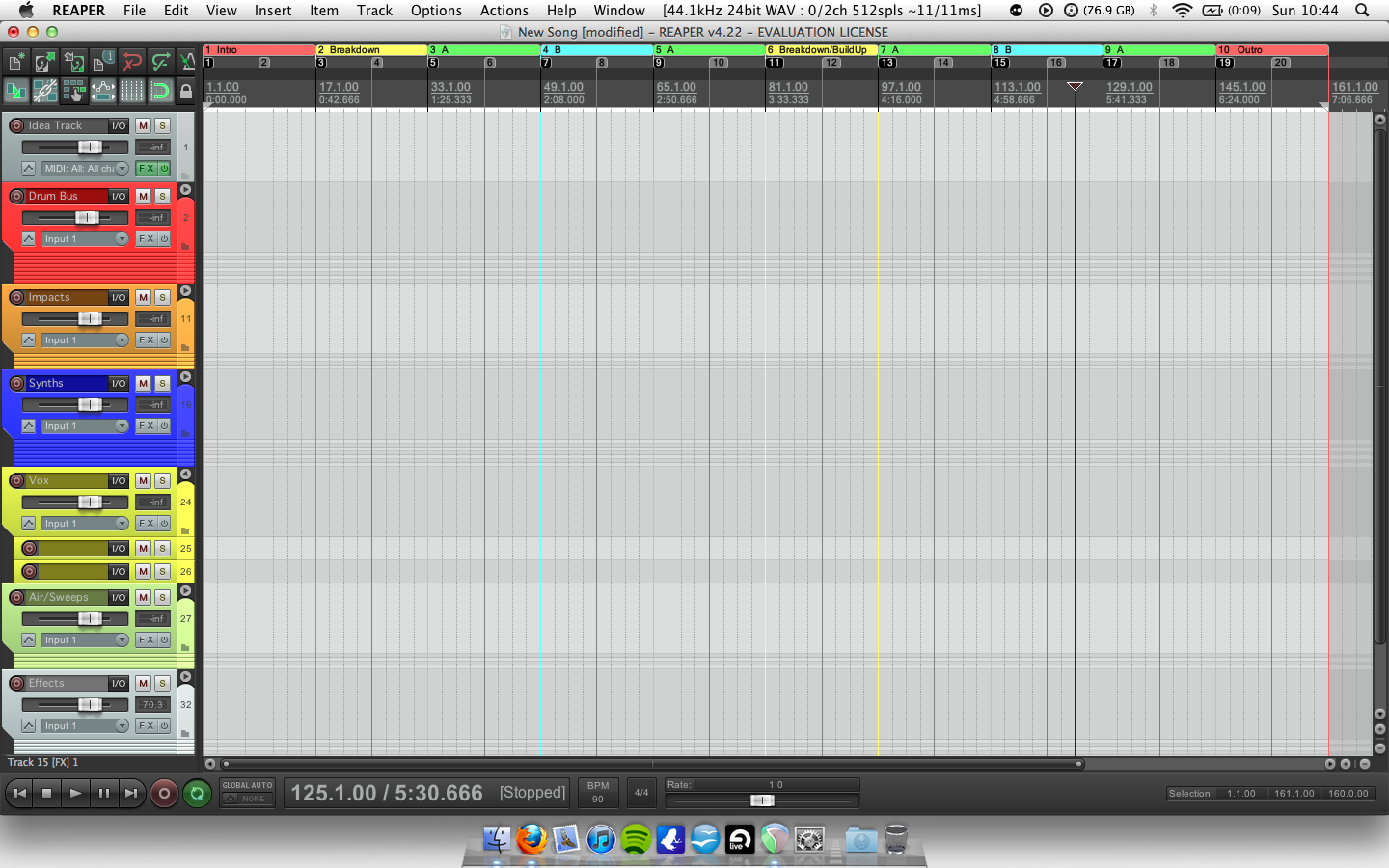
I’ve created a template in Reaper in order to help my workflow in future tracks. So here’s a brief explanation on what I’ve done, why I’ve done it, and how it’s been designed to aid me in my compositions and song writing. First of all, here’s a screen shot of the arrangement view, and I’ll go through exactly what I have available to me when I first open up Reaper.

The Tracks

Ideas Track – This is simply a Piano running in Kontakt. It means that a soon as I open up my project, I can start playing around with melody/harmony ideas. I can record these and copy them into my other tracks however I want.

Drum Bus – This is an accumulation of Battery 3 and some of my favorite samples. I’m currently trialing using Battery, as mentioned in previous posts, I used to use Ableton, and I had similar samples loaded up in a Drum Rack, but seeing as I’ve not invested in the Komplete 8 package, I thought I’d take advantage of using a more advanced sampler.  Battery is sending out the different samples into a number of busses that I’ll briefly talk about later.

Impacts – Here I have a a few audio tracks where I can simply drop samples of ‘impacts’ or ‘explosive’ types of sounds, to layer up the texture of a track.

Synths – Within this group of tracks, I have a few different basic synth patches that I’ve created as defaults that I can then manipulate and change to suit the track I’m writing. Currently, these are simply different versions of Massive, but I’ll soon change them to different synths depending on what I’m writing and what I need them for.

Vox – I have a simple mic set up in the studio, in case I want to lay down some vocal ideas, so these are simply audio tracks hooked up to my soundcard for those purposes.

Air/Sweeps – These are a few audio tracks for me to drop samples of sweeps/swooshes/wwweeeeeee sounds. However you want to describe them. These are often used for build-ups or texture purposes. ‘Air’ (such as wind, vinyl noise etc) can be used to open up a track, and add that room to breath. I can make a track feel more natural/organic, a technique used by a number of different producers.

Effects – This is a group of general effects most commonly used on my productions, and we’ll look at these in further down.

The Mixer

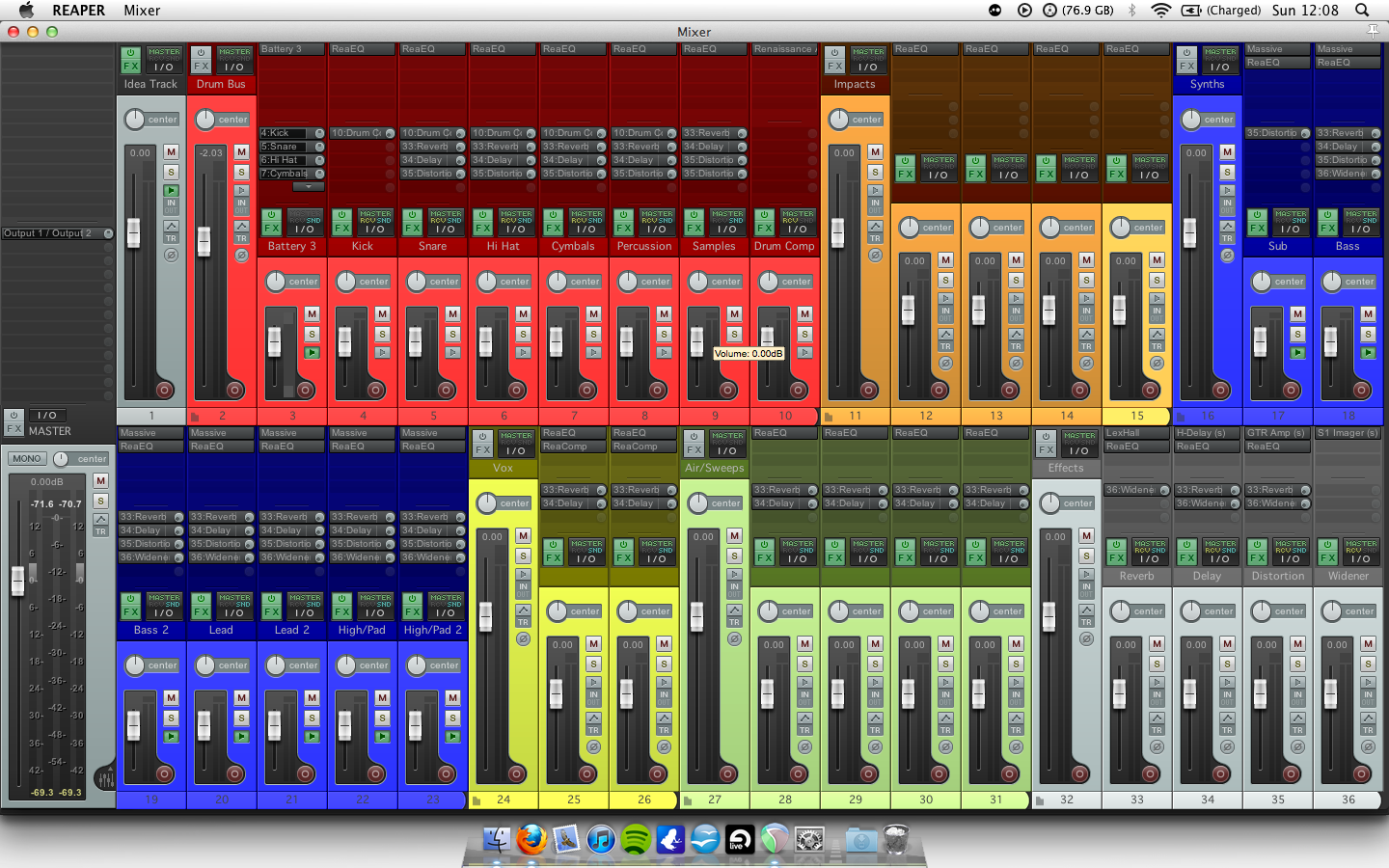
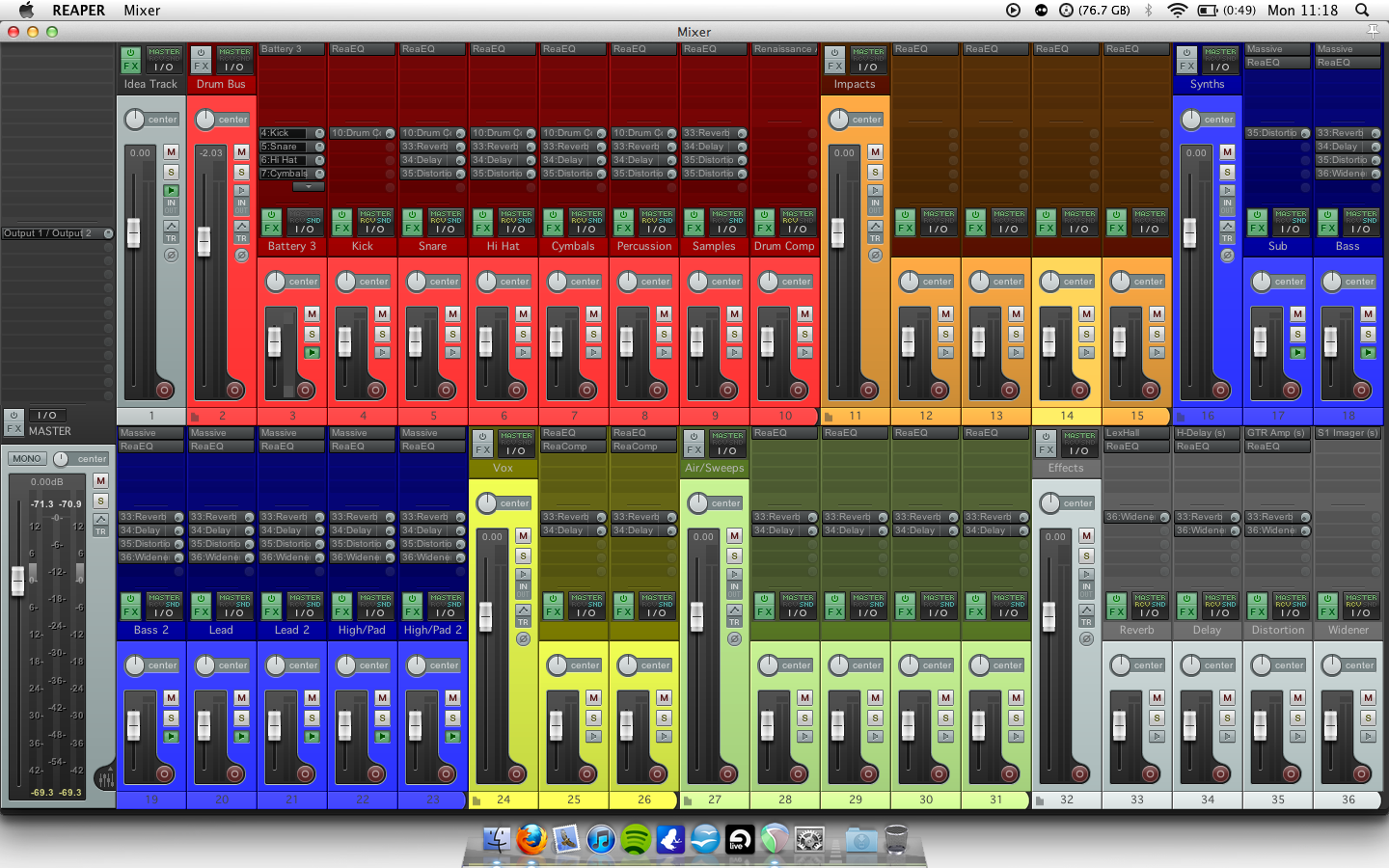
So here’s the mixer… You may have noticed that I’ve colour coded the different groups. This is simply so that it’s easier for me to see what’s where, so that I can quickly find what I need. This also makes it easier if I’m collaborating with people. They can easily look at each main group (the larger fader) and then look at the individual instruments within that track. Obviously whilst working on a track, and can change labels and make a more relevant or detailed connection between the name and the sound. Currently they’re simply things like ‘Sub’, ‘Bass’, ‘Lead’, etc.

On each track I’ve placed a flat EQ to be edited later. I believe you should never use ‘stock’ EQs. What I mean by that is you shouldn’t presume that even if you’re using the same sound/sample, that the EQ should be the same for every track your working on. Each track will have a different feel/sounds that will interact with each other differently, so they will require different EQs for each song your working on.

You may notice that I have then set up sends on different tracks to their most commonly related effect. In general Reverb will be used on most tracks, Delay, Distortion and a Widener will only be used on particular tracks, dependent on the song itself.

I haven’t placed any compressors on any of the tracks apart from a simple Drum Bus compressor. This is purely for the same reason as the EQs. You will not always need to compress a sound, so what’s the need to having it there until you need it?

Structure

You may have noticed this on the arrangement view. I have used regions and markers to help the structure of my compositions. This is something that I have sometimes struggled with in the past. It’s not that I can’t structure my pieces, but this is a simple way of reminding me about it. I’ve used a standard structure found in a lot of electronic music such as Dub-Step or House music. The markers half-way through each region are simply to remind me about introducing something new, and the are colour coded to remind me about the relations between sections etc.

I believe this template is going to help a great deal in my workflow, and in my creative flow. It will help me to sit down, and start with creating the music first, creating the instruments, and then finally producing. Hopefully I won’t get lost in what I should be doing, and this will help me to keep organized in the future a lot more. Below are a couple of video that helped to make me realize a few of these ideas, with thanks to Vespers and Dodge & Fuski. They can seem cheesy, but they’re completely relevant for people in my position and within the industry…

[Due Update] Preparing to Produce Music (2012)

Yesterday I decided to start improving my workflow. It’s been something I’ve had planned to do for a while. Simple things like cleaning and organizing the studio, creating folders and archives on my computer etc, buying external hard drives that I can store things on and make portable. Basically, everything any studio should do to get ready to create. It feels odd saying all of these, because in my head you should be able to create whenever you want with whatever you want, but to be honest when you have a day job, a house to clean and everything else to do with life it can be hard to simply sit down and start working that creative mind,  so these are simply things that I’ve done to make that process easier.

1. Clean the Studio

It’s something that should be done regularly if you’re anything like me. I have a habit of pulling out mic stands and cables, then just leaving them out set up thinking ‘I’ll use that again soon’, when in fact what really happens is I look through the doorway and go ‘It’s a mess in there, I don’t wanna work in there until it’s clean’. This just sets you back further, and discourages you from actually using the studio. So a rule I’m going to try and keep now is tidy after each session. This means that it’s clean when I next want to use it, and I don’t have to spend two hours cleaning it up again before being creative.

2. Clean the Computer

This might seem random, but it can be a very important part. So often I’ll open up track, and find that files are missing, or I can’t find the track I want to work on, or that preset that I thought I had saved. Also having tonnes of copies of tracks scattered around the hard drive, never knowing which one was the most recent edit. There are a few things that I’ve done to improve this.

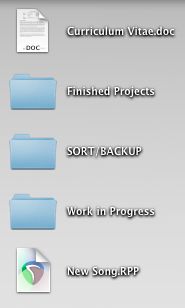
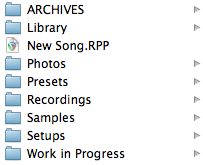
1. Create a folder system – This is something that really effects your workflow, it makes it easy to find things and means that sorting out stuff in the future is a lot easier. This actually took me a few days to sort out, as the first thing I did was ARCHIVE. It’s so easy to just accumulate all of your work and leave it where it is. This just takes up HD space, and slows down your computer, you also then end up with shed loads of copies, which becomes even harder to sort out when archiving, and even worse when you’re trying to keep two different computers organized. So, what do these look like? It’s simple.

On my desktop I have these Icons/Folders, and that’s it. I have a copy of my CV (as I’m currently looking for more work) but obviously it’s useful to have this handy when applying for work, or to add to. It also means that I don’t have to go crawling through all my documents to find the most recent copy. The Next folder is simply ‘Finished Projects’. This is what it sounds like. When I’ve finished a track or recording, the project folder and bounce go into this folder, ready to be called up if needed, but more importantly, it’s now out of the way, and I don’t feel like I have to go back and work on it again. It’s FINISHED.

Secondly I have a portable HD. This has a similar file system to what I have on my desktop, but it’s used to switch between computers when I’m wanting to work on different things. For example if I’m working on a mix down, I’ll be using it on my desktop to take advantage of my monitors, so I’ll open up the ‘Work in Progress’ Folder and work out of that. I have a samples folder so that I know where they all are, presets, so that I don’t lose them all the time, Archives for backup and finished work, then some of the others are obvious. It’s always useful to carry around a folder containing backups of Install files also (Setups), in case you ever have a system crash whilst you’re on the road and find yourself having to re-install all of your drivers etc. Yes, you can go and download them all again, but if you have access to them straight away, it makes life a lot easier.

3. Create Templates

Now this is something that I’m actually going to post separately, and look into with a little bit more detail, but I’ll give you a general idea now. Templates can be useful for a number of reasons. Obviously if you’re a DJ using something like Ableton Live, a you can set up a project/template so that you can just drag tracks in, warp them, and have the project ready with your favorite control surface so that you’re ready to mix straight away. Another reason which I have discovered more recently is simply to break the barrier that stops me from being creative, and that’s the ‘New Song’ syndrome. What is this I hear you ask? Well, basically when starting a new track you might start with a synth line, so you open up your software (wait for it to load) then you create a new track (wait for it to load) then you drop a VST onto the track (wait for it to load) then you create your instrument (bass, sub, kick, whatever). Ok, so you’ve done that, now I don’t know about you but I’ll pretty much EQ everything, so you drop an EQ on there, then maybe a compressor, then maybe you set up a send to some reverb, delay, distortion or whatever else the kids are using these days.

Hey look, we’ve made ONE track with a few notes and we’ve had to do all of that? How about the other 20+ we’re about to add to that? You may realize I’m getting frustrated, this is purely down to the fact that I’m annoyed that I never did this years ago.

Below is a screen shot of a template I’ve recently created to cure this itch, and in my next post I’ll be going into more details on what it contains and why I’ve done it, and also I’ll be posting up soon as to why I am now using Cockos Reaper, and not using Ableton or Logic etc.